Auto coin switching: when it pays and when it quietly costs you
What a profit switcher actually compares, the three costs it does not count, and why the reward scheme decides whether switching is free or expensive.
What a switcher does
A profit switcher watches several coins your hardware could mine, estimates what each would earn right now, and moves the rig to whichever looks best. Rental marketplaces do the same thing on your behalf when you sell hashrate rather than mine with it.
The pitch is obvious and the arithmetic looks unanswerable: always be on the best-paying coin. It is genuinely right some of the time. It is confidently wrong the rest, and the reason is that the comparison it makes is not the comparison that pays you.
It compares estimates, not outcomes
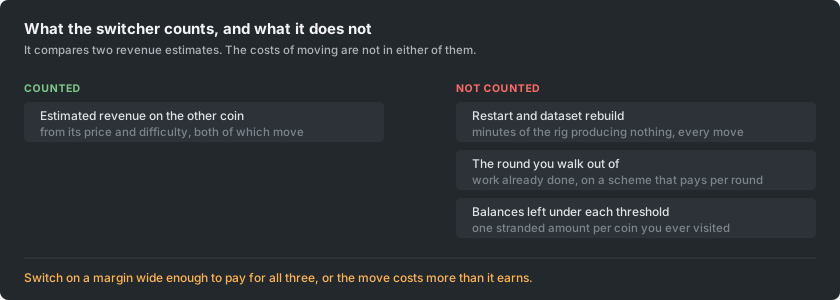
The number a switcher ranks on is revenue per unit of hashrate, worked out from a coin's current difficulty and its current price. Both of those move, and the second moves for reasons that have nothing to do with mining.
That makes the ranking a forecast with no error bar. When two coins are within a few percent of each other, which is most of the time, the ranking is inside the noise and a switcher that acts on it is trading on a coin flip while paying real costs for the move.
The first cost: the rig stops
Switching means restarting the miner, and often rebuilding whatever dataset the new algorithm needs before the first share can be produced. During that the rig earns nothing.
Once a day this is invisible. Every twenty minutes it is a permanent tax on the whole operation, and it grows with the number of cards. This is the cost people discover after a month of switching, when total earnings are lower than they were before and the hashrate charts look fine.
The second cost: the round you walk out of
This is the one that surprises people, and it depends entirely on how the pool you are leaving pays.
On a scheme that pays per round, your shares are your claim on the block that round eventually finds. If you leave before it does, you took the risk and somebody else takes the reward. Schemes designed to discourage exactly this behaviour, where payment depends on your share of recent history, make it more explicit still: leaving resets your position, and the work you had banked stops counting.
On a scheme that pays per share, this cost is close to zero. Each share was already priced when you submitted it, so walking away costs you only the time the switch takes.
So the honest version of the advice is: a switcher belongs on pay-per-share, or on a pool you stay with long enough to see rounds through. Switching frequently across round-based pools means repeatedly funding rounds that pay somebody else.
The third cost: the dust you leave behind
Every coin you visit leaves a balance somewhere. If it is under that pool's payout threshold when you move on, it stays there, and a switcher that touches a dozen coins over a month leaves a dozen small amounts stranded across a dozen pools.
Individually trivial, collectively not, and often never recovered because reaching each threshold would mean going back to that coin for long enough to earn the rest.
The two settings nobody changes
Almost every switcher exposes both of these and almost everybody leaves them at their default, which is where most of the harm comes from.
- The margin. How much better the other coin has to look before a move happens. A default near zero switches on noise. Set it wide enough that the move pays for the restart, the abandoned round and the dust it will leave.
- The minimum dwell time. How long the rig must stay put before it is allowed to move again. Without one, two coins trading places repeatedly produce a rig that spends its day restarting.
When switching is the right answer
- You rent hashrate out rather than mine with it. The buyer carries the coin risk and you are paid for the hashrate, which is the case this whole model was built for.
- The gaps between coins are genuinely large, not a few percent. Occasionally one coin does move far enough that the ranking is not a coin flip.
- You are mining to sell immediately and hold nothing, so the only thing that matters is revenue this week.
When it is not
- One or two cards. The restart cost is the same proportion of a small rig as a large one, and the extra revenue it might capture is small in absolute terms.
- You want to hold a coin you believe in. A switcher optimises this week and sells the rest, which is the opposite of that position.
- The algorithms involved need a heavy rebuild on every change. The cost per move can exceed anything the ranking difference is worth.
- Your rigs are far from the pools you would be switching between. A better coin on a distant server can be worse in your wallet once stale shares are counted.
The alternative that usually wins
Pick a coin for reasons that survive a week, mine it, and let the compounding of a rig that never stops do the work. Then review monthly with actual numbers rather than a live ranking: what your wallet received, against what the same hardware would have received elsewhere over the same period.
That comparison is worth making and worth acting on when it is decisive. It just does not need to be made every fifteen minutes, and made that often it costs more than it finds.