Mining and tax: what to record and why the record is the hard part
The two moments that nearly every country treats separately, why hourly payouts make the record harder than the rules, and exactly what to keep so the year is possible to file.
Read this first
This is not tax advice and it cannot be. Rules, rates, thresholds and definitions differ by country and change, and how they apply depends on facts about you that an article cannot know. What it can do is describe the shape of the question, so that when you do sit down with somebody qualified you arrive with the right records rather than a year of guesses.
The one genuinely universal piece of advice in this article is at the bottom, and it is to start keeping the records now rather than in filing season, because the information you need is easy to collect as it happens and close to impossible to reconstruct afterwards.
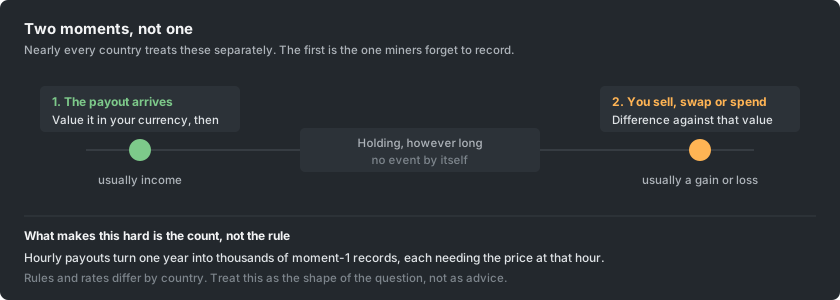
Two moments, not one
Almost every tax system that has addressed mining treats it as two separate events, and conflating them is the most common mistake miners make.
The first is when the coins arrive and become yours. Most systems treat that as income, measured by what the coins were worth in your own currency at that moment. The second is when you later sell, swap or spend them. That is a separate event, and what matters there is the difference between what you get and what the coins were valued at when you received them.
Holding, however long, is not usually an event by itself. The price moving while you hold is not the point; the point is what you do at each end.
Why the record is harder than the rule
The rule fits in a sentence. Applying it does not, and the reason is the payout schedule.
A pool that pays hourly generates a receipt event every time it pays you. Over a year that is thousands of them, each needing the value of that specific amount, of that specific coin, at that specific hour, in your currency. Nobody reconstructs that in April from memory, and using one price for the whole year is both wrong and obviously wrong to anyone who checks.
This is the practical case for collecting as you go, and it is why the tooling around this exists at all. Whatever you use, it needs the same inputs, and they are all available while they are happening.
What to keep
Per payout received:
- The date and time it arrived.
- The amount and which coin it was.
- What that amount was worth in your own currency at that time.
- The transaction id, and the wallet address it went to.
And separately, for the year as a whole:
- What you paid for the hardware, and when.
- Electricity attributable to mining, which is a great deal easier to defend if the rigs are on their own meter.
- Pool fees and any miner developer fee, both of which come out of what you were credited.
- Every later sale, swap or spend of mined coins, with the same fields as above.
Where those numbers come from here
Your payments page lists every payout with its timestamp, its amount and its transaction id, and your dashboard carries the same per-worker history. The public API serves the same records, which is the practical route for anyone with enough payouts to make manual copying unreasonable, and the API reference documents the endpoints and their fields.
The one number the pool does not hold is the price in your own currency at each payout time. That comes from whichever price source you and your accountant agree to use, applied consistently. Consistency matters more than which source you pick: switching mid-year is the thing that is hard to explain.
Hobby, or business
Most systems distinguish between mining as a personal activity and mining as a business, and the difference changes both what you owe and what you can deduct. Where the line sits varies, but the questions asked are recognisably similar: how organised is it, how much is at stake, is it run in a way that looks intended to profit, how much of your time does it take.
Two examples, offered as examples and not as a list. The United States taxes mined coins as ordinary income at their value when received, and treats the activity as self-employment when it amounts to a trade or business rather than a hobby, which brings its own additional tax. The United Kingdom asks whether the activity amounts to a trade at all, using long-standing tests; where it does not, the value of what you received is still taxable as miscellaneous income, and later disposals are looked at separately again.
The pattern in both, and in most others, is that a bigger and more deliberate operation is treated more like a business: more that can be set against the income, and more obligations that come with it.
What usually goes wrong
- Nothing recorded at receipt. The single most expensive mistake, because the second event cannot be worked out without the first, and by then the prices are historical.
- One price for the whole year. Convenient, wrong, and visibly wrong.
- Only the sale is declared. The income at receipt is a separate event and does not disappear because you have not sold.
- Mining and personal coins in one wallet. Untangling which coins came from where, years later, is the situation everybody advising on this warns about. Use a separate wallet or account for mining from the start.
- Deductions with nothing behind them. Electricity and hardware are often deductible in some form, but only with something to show, which is why the meter is worth the trouble.
- Assuming small means exempt. Thresholds exist in many places, but they are usually about whether you must file, not about whether the income counted.
The one recommendation
Get the records right now, and get somebody qualified in your own country to tell you what they mean. The records are the part only you can produce, they cost almost nothing while the payouts are arriving, and every professional you might hire will start by asking for exactly the list above.