Powering a rig: connectors, risers and the circuit it plugs into
What each connector is rated to carry, why the SATA-powered riser is the classic rig fire, and how to work out what one wall socket can actually run.
The part that actually goes wrong
Cards do not usually kill rigs. Connectors do. Almost every burnt smell, browned plug and mysterious reboot in a mining rig comes down to a piece of copper being asked to carry more current than it was designed for, continuously, for months.
That makes this the one area where the numbers are worth knowing rather than approximating, because the failure mode is not a card that stops working. It is heat where you did not plan for heat.
One cable per socket on the card
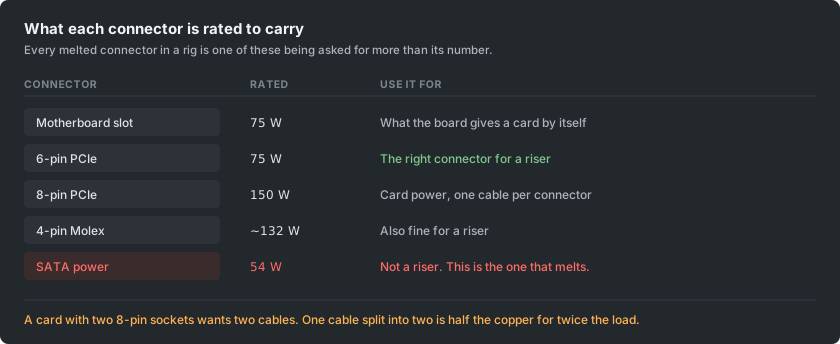
An 8-pin PCIe connector is rated for 150 watts, which at 12 volts is around 12.5 amps through that plug and the wire behind it. A 6-pin is rated for 75, and the motherboard slot supplies another 75 by itself.
Many power supplies ship cables with two connectors on one lead, a second plug hanging off the first. That exists for cards that draw little, and it is the single most common mistake in a rig. Feeding a card's two 8-pin sockets from one such cable asks that one lead to carry both, around 25 amps, through wire chosen for half of it.
The rule is simple and has no exceptions worth taking: one cable from the power supply per socket on the card. If the supply does not have enough separate cables, it is not the right supply for that card, and no adapter changes that.
The SATA riser, which is the classic rig fire
A riser needs its own power because it is feeding the card the 75 watts the slot would normally provide. Risers ship with a choice of sockets, and one of them is wrong.
A SATA power connector is rated for 54 watts. A riser can be asked for more than that. It is a connector designed for drives, with small flat contacts and a habit of being crimped rather than soldered, and it is being asked to carry more than its rating around the clock. This is why photographs of melted SATA plugs are a genre.
Use the 6-pin PCIe socket on the riser, or Molex, which is rated far higher. If a riser only offers SATA, it is a riser to throw away rather than to adapt, and a SATA-to-Molex adapter makes it worse rather than better: the weak connector is still in the chain, now with an extra joint.
Do not chain several risers onto one cable either. Count the watts on the cable, not the number of plugs it happens to have.
The newest connector deserves its own care
The 16-pin connector on recent high-power cards has a well-documented history of overheating and melting. A revision shortened the sense pins so a plug that is not fully seated is more likely to be noticed, but reports of melting have continued, because the underlying problem is a card drawing close to what the connector is rated for through contacts that must all share the load evenly.
If you run one: seat it until it clicks and then check it has not been pulled at an angle by the case, avoid tight bends near the plug, do not use a third-party adapter unless you have a specific reason to trust it, and look at it occasionally. A card running near its limit for months is a harder life than the desktop use these connectors were reviewed under.
Sizing the supply
Add up what the cards draw at the power limit you actually run them at, not at their default, then add roughly 100 watts for the board, processor, drive and fans. Then leave headroom rather than sizing exactly to the total.
The reason for headroom is efficiency rather than safety. A supply is at its most efficient somewhere in the middle of its range and worst at both ends, so a unit run permanently near its ceiling wastes more of what you pay for and runs hotter doing it. An 80 Plus rating is a measure of that efficiency, and on a machine that runs continuously the difference between tiers is real money rather than a specification-sheet detail.
Two supplies in one rig is normal above a certain size, and the thing to get right is that they start together and share a common ground, which is what a synchronisation adapter is for.
What one socket can actually run
This is the constraint people meet last and should meet first, because it is the one that involves the building rather than the rig.
Circuits are not rated for continuous use at their full number. A load running for hours on end is treated as continuous, and the accepted limit for that is 80 percent of the circuit's rating. On a 15 amp circuit at 120 volts that is 12 amps, about 1,440 watts. On a 20 amp circuit, 16 amps, about 1,920. On a 16 amp circuit at 230 volts it is roughly 2,900 watts.
That is the whole circuit, not the socket: everything else on the same breaker counts against the same number, which is how a rig that has run for months trips a breaker the first time somebody uses a heater in the next room.
And the wall figure is higher than the sum of the cards, because the supply is not perfect. A rig drawing 1,200 watts of components pulls perhaps 1,300 from the wall. Measure it with a plug-in meter rather than adding up specifications: it costs very little and it is the only number the breaker cares about.
Things worth doing once
- Buy the power cables from the same manufacturer as the supply. Modular cables are not a standard, and a cable from another unit can have a different pinout, which destroys hardware immediately rather than gradually.
- Feel the connectors after the first hour at full load. Warm is fine, hot is not, and hot at one plug tells you which one.
- Keep a spare riser. It is the part most likely to fail and the cheapest to have on the shelf.
- Put the rig on its own circuit if you can. It removes the entire class of problem where something else in the house decides your uptime.