Why the same card is not the same price, and what that does to payback
Duty, tax, freight and currency turn one list price into many. How to work out what a card really costs you, what that does to the payback figures on the hardware table, and when importing yourself is worth the trouble.
The list price is not the price
The hardware table prices every card at its manufacturer list price in US dollars, because that is the one figure that exists for every card and is comparable across all of them. In much of the world it is also not what you pay, and the gap is not small.
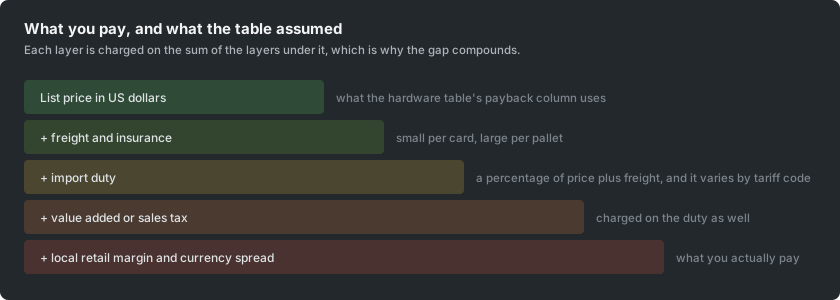
What turns one into the other is a stack, and each layer is charged on the sum of the layers beneath it, which is why the difference compounds rather than adds.
Working out your own landed cost
The method is the same everywhere even though the rates are not. Start from the price in the currency it is sold in. Add freight and insurance to get the value your customs authority will assess. Apply the duty rate for the tariff code the goods fall under. Then apply your sales or value added tax to that whole total, duty included. Add whatever the local seller takes, and the spread you pay when you change currency.
Two details decide most of the outcome. The first is the tariff code: graphics cards, complete computers and mining specific machines do not always fall under the same code, and in some countries computer parts enter at a low or zero rate under long standing information technology agreements while the finished machine does not. The second is whether you are buying locally or importing, because a local purchase has already had all of this applied and priced in.
What this does to the payback column
Payback on the hardware table is the card price divided by what it earns, so it moves in direct proportion to what you actually paid. A card whose landed cost is half again the list price does not pay back in the number shown; it pays back in one and a half times that number.
This is exactly why the table lets you type your own price into any row. The revenue and profit figures are computed from the coin, the difficulty and your electricity price, and none of those care what you paid for the card. Once you replace the price with the one from your own invoice, the payback and the ranking by payback become yours rather than a United States buyer's.
The same applies to the hashrate and power columns, which are also editable, and are worth correcting if you have measured your own card rather than trusting a benchmark taken on a different cooler in a different room.
Used hardware, and what crossing a border does to it
A used card is often the better arithmetic, and the used market article covers how to judge one. What changes across borders is the part that is not the price.
Manufacturer warranties are frequently regional, so a card bought abroad may have no coverage where you live even while its term is still running. Returning a faulty card to another country costs freight both ways and can trigger duty again on the replacement. And a card bought second hand privately usually has no coverage at all, whichever country it is in.
None of that argues against used hardware. It argues for pricing the risk honestly: a card with no realistic path to a warranty claim is worth less than the same card with one, and the difference belongs in the price you are willing to pay.
When importing yourself is worth it
Importing directly can beat the local price, and it can also lose to it once everything is counted. The honest comparison is the landed cost above against the local retail price, including the value of what you give up.
Importing tends to win on larger orders, where freight per card falls and the saved retail margin is multiplied. It tends to lose on single cards, where freight and the fixed costs of clearance are spread across one item, and where the local seller's obligation to take a faulty card back has real value.
One thing that is not optional either way: find out how mining hardware specifically is treated at your border before it ships. In some places it is ordinary computer equipment and in others it is not, and equipment held or seized at customs is a much more expensive problem than a percentage on the invoice.