Undervolting: why running slower usually earns more
The physics that makes less power cost less work than it saves, how to find your own best point, and why the number to optimise is not hashrate.
The wrong number
Almost everybody tunes a rig by watching hashrate, because that is the number the miner prints biggest. It is the wrong one, and it is the reason so many rigs are set up to earn less than the same hardware could.
What you actually sell is work. What you actually pay for is watts. So the number that decides whether a rig makes money is work per watt, and hashrate on its own says nothing about it.
Why the trade is not even
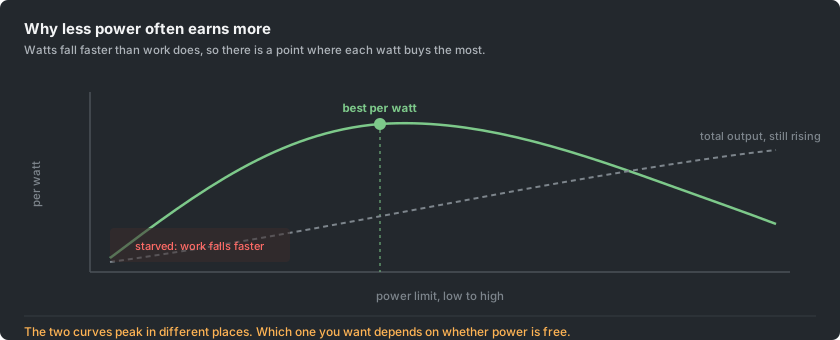
A card's power consumption rises roughly with the square of its voltage, while the work it does rises roughly in line with its clock speed. Those are different curves, and the gap between them is the whole opportunity.
Pushing the last few percent of clock out of a card costs voltage, and voltage costs power squared. So the final stretch of performance is bought at a terrible rate, and giving it back returns far more watts than it costs work.
When it is worth it, and when it is not
If electricity is free to you, ignore all of this and run the cards flat out: total output is what you want and it peaks at the top of the range.
If you pay for electricity, and almost everyone does, the peak you want is the other one. Every watt saved is money kept, and it is kept every hour of every day, which is what makes a few percent compound into something that matters.
There is a third reason that has nothing to do with money. A card run below its limit is cooler and quieter, its fans work less and last longer, and the whole rig ages more slowly. That is worth something even if the arithmetic came out even.
Finding your own point
Nobody else's settings are your settings. Two identical cards from the same box differ, and the difference is large enough to matter. So this is a measurement, not a copied number.
- Measure at the wall. A plug-in meter costs very little and is the only thing that sees the whole rig: the supply's losses, the risers, the board and the processor. The number the driver reports is the card alone, and tuning on it hides a chunk of what you pay.
- Change one thing at a time and give each setting long enough to be meaningful. Thirty minutes minimum; an hour is better, because thermal behaviour settles slowly.
- Work downward in steps. Drop the power limit, record the work and record the watts, repeat. The ratio climbs at first. Keep going until it stops climbing.
- That point is your answer. Past it the card is being starved and work falls faster than power, which is the other side of the same curve.
- Then test stability for a full day before trusting it. An undervolt that is very slightly too aggressive does not crash, it produces work that fails validation, which is worse: the rig looks busy and earns less.
Core and memory are different problems
On most algorithms one of the two does the work and the other is along for the ride, and which one it is depends on the algorithm rather than the card.
Where memory does the work, the core can often be dropped a long way with almost no loss, and that is where the easy watts are. Where the core does the work, the reverse holds and memory can usually be left alone or brought down.
Memory is also where the caution belongs. Pushing memory clocks up is the classic way to gain a few percent and lose more than that to failed shares, and the failures do not always announce themselves. If you tune memory upward at all, watch the reject rate for a day afterwards rather than the hashrate for a minute.
Check it on the pool, not the console
A tune is finished when the pool agrees with it. The miner's console reports what the card attempted; your dashboard reports what actually arrived and was accepted, and that is what you are paid for.
So the last step is to compare a full day at the new setting against a full day at the old one, using the dashboard average rather than the live figure, and to check the reject rate has not moved. An undervolt that improved watts and quietly cost you a few percent of accepted work is not an improvement, and the console will never tell you.