Choosing your payout threshold: the arithmetic
What the minimum payout actually controls, why batched payouts change the usual advice, and how to pick a number instead of guessing at one.
What the threshold does
Your payout threshold is the balance you have to reach before the pool sends you anything. Below it, what you earn accumulates. At or above it, the next payment round pays you out and the balance resets.
It does not change what you earn. Every share you submit is credited the same either way. What it changes is how often that credit turns into a transaction on the chain, and each transaction has a cost.
The cost of a payout is the network, not the pool
Sending coins costs a network fee. It is paid to the chain, not to the pool, and it is why a threshold exists at all: without one, a rig earning small amounts would generate payouts so small that the fee ate a serious fraction of each.
So the arithmetic is a ratio rather than an amount. A fee is not expensive or cheap on its own, only relative to what it is moving. The same fee is trivial on a large payout and ruinous on a tiny one.
Batching changes the usual advice
The common advice, set your threshold high to avoid fees, is written for the case where each payout is its own transaction. That is not how pool payouts generally work.
A payment round pays many miners in a single transaction with many outputs. The transaction carries one fee, and adding one more recipient to it costs far less than sending a whole separate transaction. Your share of that fee is correspondingly small, and it does not fall in proportion when you double your threshold, because you were never paying for a transaction of your own.
The practical consequence: raising a threshold saves less than people expect, and the reasons to raise it are usually not about fees at all.
Who pays it, and how to see
Whether the network fee comes out of your payout or is absorbed by the pool is a per-pool setting, so the honest answer is to look rather than to assume. Your payments page shows every payment with its fee and the number of miners it paid, which answers both questions at once: what a payment actually costs to send, and how many people that cost was spread across.
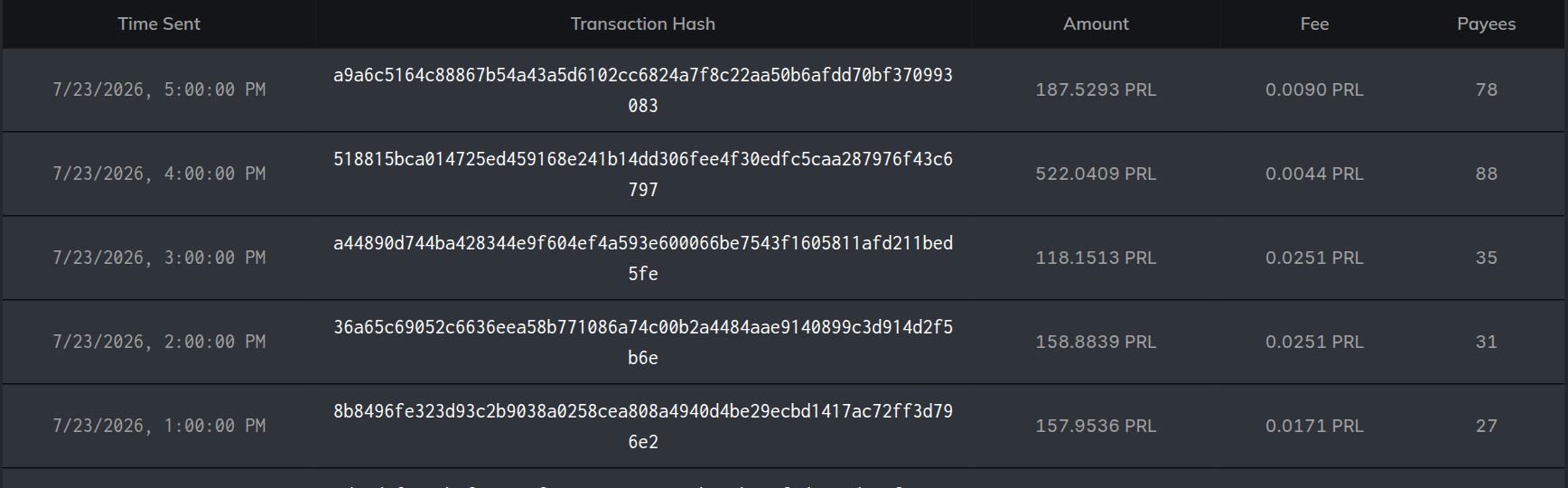
Take a few recent rows and divide the fee by the payee count. That is the real per-miner cost of one payout on this chain at current network conditions, and it is the number every decision below turns on.
The rule of thumb
Set your threshold so that the per-miner share of the fee is comfortably under one percent of the payout. Under that, the cost of being paid is a rounding error against the variance in what you earn anyway. Above a few percent, you are working for the chain.
Two things move that number without you touching anything. Network fees rise and fall, so a threshold that was fine can stop being fine on a congested chain. And a coin's price moves, so a threshold set in coins is a different amount of money month to month. Both are reasons to look again occasionally rather than to set it once and forget.
What a low threshold really costs
- More fee events, though less than intuition suggests, for the batching reason above.
- More records. If you have to account for mining income where you live, every payout is a separate thing to record and value. Paying four times as often means four times the paperwork for the same money, which for some people is the largest cost on this page.
- More dust. Frequent tiny amounts arriving at a wallet become small unspent pieces, and spending a wallet made of small pieces later costs more than spending one made of large ones.
What a high threshold really costs
- Your balance sits with the pool rather than in your own wallet. Nothing about the pool changes that this is somebody else's server, and the whole point of a non-custodial payout is to shorten the time your coins spend there.
- You are exposed to the price for longer without choosing to be. Waiting a month to be paid is a decision to hold for a month, whether or not you meant it that way.
- A small miner can wait a very long time. Work out how long your hashrate takes to reach the number before you set it, because a threshold you reach twice a year is effectively a savings account you cannot withdraw from.
- If you stop mining below it, the balance stays. Most pools hold it for you, but it will not move on its own.
The cases where the answer is easy
Testing a new rig or a new pool: set it low. You want to see a real payout arrive at your real wallet as early as possible, because that is the only thing that proves the whole path works end to end. The fee is worth it once.
Stopping mining: set it low before you stop, not after. Reaching a threshold needs hashrate, and you are about to have none.
Steady, and mining is meaningful money: work out the per-miner fee share from your own payments page, then pick the smallest threshold that keeps it under one percent. That is the answer, and it is a different number for a single card than for a farm.
Setting it
The threshold is set from your dashboard, on the same settings panel as your other miner preferences, and it takes effect from the next payment round. The pool applies its own minimum underneath whatever you choose, so a number below that floor is simply raised to it rather than refused.