Share reject reasons: what the pool told your miner
Every reply the pool sends when it declines a share, what each one actually means, and which ones point at something you can fix.
The reply is the diagnosis
When the pool declines a share it does not just say no. It sends back a numbered reason, and your miner prints it. That one line is the difference between changing settings at random for an hour and fixing the actual problem in a minute, so it is worth knowing what each reply means.
Some of these mean something is wrong at your end. Some mean nothing is wrong at all. Reading them the same way is how people end up re-flashing a card that was fine.
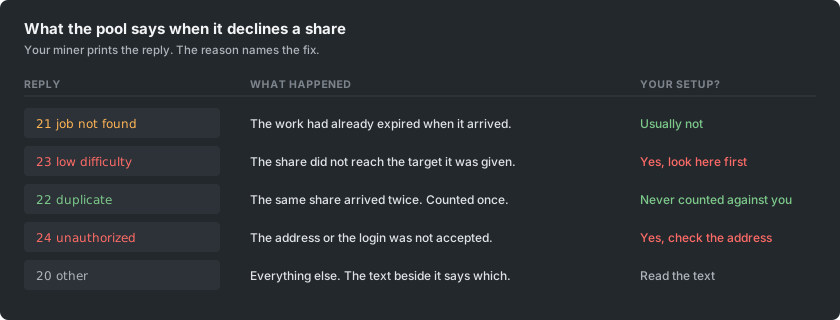
21, job not found
The work you answered had already expired. The network moved on while your share was in flight, so by the time it arrived the question it answered had a winner. This is the stale share, and a small number of them is simply the cost of being on the internet: light through fibre is not instant.
It is worth acting on only when it stops being small. A rate that climbs week after week points at latency, so try the region closest to you and a wired connection before anything else. A rate that jumps the moment you add a rig points at that rig.
23, low difficulty
Your share did not reach the target it was given. This is the one that usually means something at your end, and it is the first place to look when rejects appear.
- An unstable overclock. Work that fails verification only sometimes is the classic signature: it is not every share, it is a few percent of them. Drop the core and memory clocks to stock and see whether the rejects go with them.
- The wrong algorithm. If the miner is started on the wrong one, essentially nothing it produces can pass, so this shows up as rejects everywhere rather than a few percent.
- An out-of-date miner. After a network upgrade an old build keeps producing work under the old rules, and every share of it fails.
- A fixed difficulty you set too high by hand. If you pinned one, remove it and let the pool tune your pace.
22, duplicate, and why it is not held against you
The same share reached the pool twice. It is counted once, which is correct, but it is worth being explicit about what happens next here: nothing. A duplicate is never counted as a bad share and never moves you toward a ban.
That is a deliberate decision rather than an oversight. Duplicates are usually the hardware being hardware. ASIC firmware retries a submission it thinks was lost, a proxy layer re-sends, and a miner that produces the same answer twice for the same work sends it twice. None of that is the miner cheating, and pools that treat duplicates as invalid quietly punish rigs for behaviour their firmware chose.
If duplicates are constant rather than occasional, the usual cause is two rigs sharing one worker name. Give every rig its own.
24, unauthorized
The login was not accepted, or a share arrived before one was. In practice this is almost always the wallet address: a typo, a space that came along with a copy and paste, or an address for a different network than the one you are pointed at.
The pool tries to say which. If an address is valid but belongs to another network, the reply says so and names the network this pool is on, because a wrong network and a typo look identical in a log and need completely different fixes.
20, other
Everything that is not one of the four above. The reply carries text beside the number saying what happened, so this one is read rather than looked up.
Two worth recognising, because they are policy rather than a fault in your work. If your stale rate stays high for a long time you will first see stale shares being rejected outright, and after that a temporary ban. Both replies say plainly that stale shares are the reason. They are not a verdict on your hardware; they are the pool declining to keep paying for work that cannot pay, and they clear on their own once the rate comes back down.
How much is too much
For job-not-found, under one percent is healthy on a well-chosen region, and nothing reaches zero. Watch the trend rather than the count.
For low-difficulty, the honest answer is different: any steady amount means something is wrong. It is not a tax you pay for being online, it is work that failed verification, and it earns nothing. A rig at a few percent is a rig with an overclock to walk back.
You can watch both as they happen on the Live tab of your dashboard, which shows every share as the pool judges it.
If the reply does not tell you enough
Work through the checklist in the rejected shares article, which orders the causes by how often they turn out to be the culprit. If one rig rejects and the others are clean, the problem is that machine rather than the pool: suspect its overclock profile, then its driver version, then its riser cables, in that order.