Do stale shares get paid?
No, on any pool and under any reward scheme. Why late work cannot pay, how stale differs from rejected, and how to get your rate under one percent.
The short answer is no
A stale share is not paid. That holds on every pool, under every reward scheme, and it is not a policy any of them chose. The work was real, your hardware did it, and the arithmetic in it was correct. It simply arrived after the answer stopped being worth anything, and no payout rule can change that, because there is no reward left to share out for it.
Why late work cannot pay
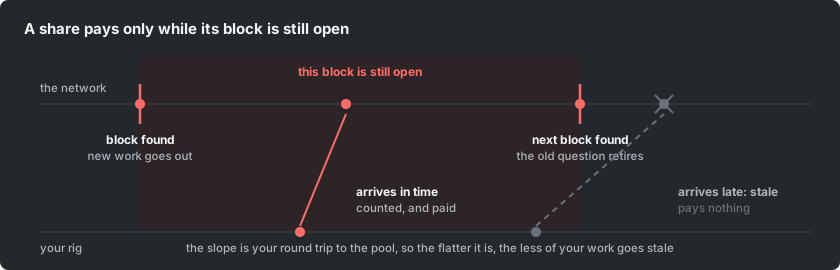
Every share you submit is an answer to one specific question: the block the network is building right now. The moment anybody in the world finds that block, the question is retired and every miner on every pool is handed a new one. If your answer to the old question is still crossing the internet when that happens, it lands too late. It is a correct answer to a puzzle nobody is solving any more.
That is the whole of it. A stale share is not discarded for being wrong, and it is not thrown out to be strict. It refers to a block that already has a winner, so it can no longer help find one, and a pool can only pay out of the blocks it finds.
Stale, rejected and orphaned are three different things
These get used interchangeably and they are not the same event. Only one of them is normal.
| Term | What actually happened | Paid? |
|---|---|---|
| Stale share | Valid work that reached the pool after the network had moved to the next block | No |
| Rejected share | Work that failed validation: wrong algorithm, below your assigned difficulty, malformed, or a duplicate | No |
| Orphaned block | A whole block the pool found that lost the race to another block at the same height | No, that block earns nothing |
The distinction matters when you are diagnosing. A trickle of stale shares needs no action. Rejected shares in any quantity mean something in your setup is wrong and should be fixed. An orphaned block is luck, and nothing you can influence from a rig.
Does the reward scheme change the answer?
No, and this is where people get caught out, because PPS is usually described as being paid for every share you submit. The accurate wording is every share the pool accepts. A stale share is not accepted, so it sits outside the deal, exactly as it does under PPLNS, proportional and solo mining.
There is no scheme in which a pool can pay for work that cannot help find a block, because that money would have to come from somewhere, and the only place available is the other miners. What the scheme does change is how your accepted work is paid: smoothly, in proportion to a round, or all at once when you find a block yourself. That choice is worth understanding, and the reward schemes article in this Help Center covers it. It has no bearing on late shares.
Any pool advertising that it pays for stale shares is either paying you with other miners' money or counting something else and calling it a share.
What a normal stale rate looks like
Under one percent is healthy on a well-chosen server region. Nothing reaches zero: light through fibre is not instant, so on every pool there is always a slice of your work in flight when the block changes. The number to watch is the trend, not the count. A steady low figure is the cost of being on the internet. A figure that climbs week after week is telling you something changed at your end.
It is also worth knowing that a hidden stale share costs you exactly what a reported one costs. A pool that folds late work into a padded hashrate figure has not made it pay, it has only made it invisible, so comparing pools by dashboard hashrate rewards whoever rounds up the most. The comparison that survives contact with reality is what lands in your wallet over weeks.
How to bring your stale rate down
- Mine the closest region. This is by far the biggest lever, because the round trip between your rig and the pool sets the width of the window in which your work can go stale. Run the latency test instead of guessing from the map.
- Prefer a wired connection. Wi-Fi adds latency and, worse, adds jitter, and it is the jitter that produces stale bursts rather than a steady low rate.
- Back off an aggressive overclock. An unstable core or memory clock makes the miner stutter and re-submit, and that shows up as staleness long before it shows up as a crash.
- Find the one bad worker. A single rig on a failing cable or riser can drag your whole account average up. The per-worker view tells you which one it is, so you are not tuning five machines to fix one.
- Rule out the path, not just the rig. A consumer router under heavy load and an ISP that reroutes at peak hours both add latency at precisely the hours you are least likely to be watching.
When it is not your fault
Sometimes the path between you and the region degrades for reasons neither end controls: an ISP reroute, congestion at an exchange point, a cable maintenance window. The signature is a jump across all your rigs at once rather than one rig drifting away from the others. Re-run the latency test before touching any hardware, and if a different region has become closer in practice, move to it and move back later.