Heat, noise and dust: running a rig where you actually live
Why a rig is a heater rated at its own wall draw, why intake air is a floor no fan can beat, and the practical limits on putting one in a home.
Two facts that decide everything else
Nearly every problem with a rig in a house comes back to one of two things, and neither is a matter of tuning.
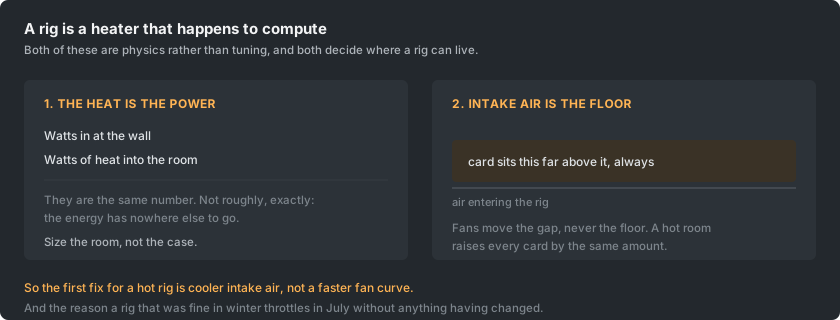
The first: every watt a rig draws from the wall leaves it as heat. Not most, not roughly, all of it. Computing does not consume energy, it moves it around and the energy ends up in the room. A rig pulling 1,200 watts is a 1,200 watt heater that happens to compute, which is the same as a small electric fire running permanently.
The second: air cooling cannot bring anything below the temperature of the air arriving at it. Fans change how far above the intake temperature a card sits. They cannot change the floor.
What that means in practice
It means the first fix for a hot rig is nearly always cooler intake air, not a more aggressive fan curve. Turning the fans up in a room that is already warm buys a few degrees and a lot of noise.
It means a rig that ran perfectly all winter can throttle in July with nothing changed. The room got warmer, so every card got warmer by the same amount.
And it means a small closed room is the worst place for one. The heat has nowhere to go, the room warms, the intake air warms with it, and the cards climb until they throttle. A rig in a cupboard does not need a better cooler, it needs the cupboard opened.
Where the heat should go
- Out of the room, not around it. A fan that stirs the air in a sealed room raises the average temperature. It has to leave, through a window, a duct or an open door to somewhere much larger.
- In one side and out the other. Cold in low, hot out high, with the rig between them. Cards that inhale their neighbour's exhaust are why the middle card in a row is always the hottest.
- Somewhere useful in winter. A rig genuinely heats a room, and if you were heating that room anyway the electricity is doing two jobs. This is the one seasonal argument in mining that actually holds.
- Somewhere else in summer, if you can. A room that has to be cooled costs you twice: once to make the heat and again to remove it.
Noise, honestly
A rig is loud, and it is loud all the time, which is a different thing from loud. Fan noise rises steeply with speed, so the last few hundred revolutions per minute cost far more noise than they buy cooling, which is another reason to attack intake temperature instead.
Sustained noise is also a health question rather than only a comfort one: exposure limits at work start counting at levels a rig in a small room can reach. If you have to raise your voice to be heard next to it, do not sleep in that room.
What actually helps, roughly in order of effect: put it somewhere else, undervolt so the fans have less to do, replace loud fans with better ones rather than more of them, mount it so nothing resonates, and only then consider enclosing it, which trades noise for heat and usually loses.
Dust
A rig is a very effective air filter that nobody empties. Dust settles on heatsinks, insulates them, and the card gets hotter for the same load until the fans are working harder to achieve less.
- Filter the intake rather than the whole thing, and clean the filter instead of the rig. This is the single change that saves the most work.
- Aim for more air coming in than going out, so what leaks in through gaps is filtered air rather than dust.
- Blow it out with compressed air, holding each fan still while you do. A fan spun by air becomes a generator and can put voltage where it does not belong.
- Never use a household vacuum on it. Static, and enough suction to move small components.
- Off the floor, and not on carpet. That is where the dust is.
- Once a month is a reasonable interval in a normal home, and more often if anyone smokes or there are animals.
Damp and cold
A garage, a shed or a basement solves the heat and the noise at once, and introduces the one risk a warm room does not have.
Condensation forms when a surface is colder than the dew point of the air around it. A rig that is running stays warm and is generally safe. A rig that has been off in a cold space and is then started, or one carried from cold into a warm room, can have water on it before it is switched on.
The practical rules: leave it running rather than cycling it on and off in an unheated space, let cold hardware reach room temperature before powering it, keep it off a cold floor, and if the space is genuinely damp, deal with the damp rather than the rig.