Hashprice: the one number that says what your hashrate is worth
What a unit of hashrate earns per day, where the number comes from, and why it moves when you have changed nothing at all.
The question it answers
Hashrate on its own tells you nothing about money. A card doing twice the work of another can easily earn less, on a different coin, on a different day.
Hashprice is the bridge. It is what one unit of hashrate earns in a day, expressed in money, and it is the only figure that lets you compare a coin against itself last month or against a different coin this afternoon. The term came out of the professional mining world, where it is quoted the way a commodity price is quoted, but the arithmetic applies to any proof of work coin.
How the number is built
Take everything the chain pays out in a day. That is the block subsidy plus the transaction fees, multiplied by how many blocks the chain produces in a day.
Divide it by the total hashrate on the network, because that is who the payout is being split between. What you have now is coin per unit of hashrate per day. Multiply by the coin price and you have hashprice.
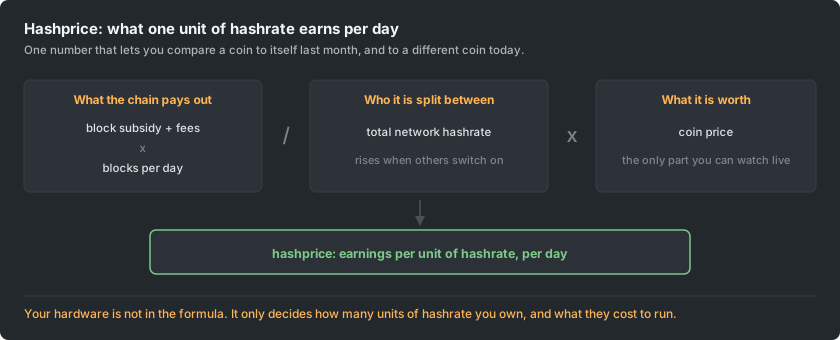
Notice what is absent. Your card is not in it. Your electricity is not in it. Hashprice is a property of the coin and the market, and it would be the same number if you switched off. That is exactly what makes it useful for comparing.
Why it moves when you did nothing
Three inputs move, and they move for reasons that have nothing to do with you.
- Network hashrate. When other people switch machines on, the same payout is divided more ways and your earnings fall in direct proportion. This is the one that quietly erodes a good deal over months.
- Coin price. The most visible input and the one people watch, though over a year it is often not the largest mover.
- Fees and the subsidy. Fees rise when the chain is busy. The subsidy falls on a schedule the chain has published in advance, and on halving coins it falls by half in a single block.
The useful discipline is to look at the three together. A price rise that arrives alongside a hashrate rise can leave you no better off, and it is common for exactly that to happen, because a higher price is what attracted the extra hashrate.
Comparing two coins with it
Two coins with different algorithms cannot be compared by hashrate at all. Their units mean different things and the numbers are not on the same scale.
They can be compared by hashprice, but only after you convert to what your own hardware does on each one. The chain is what you have to do: your card's hashrate on that algorithm, multiplied by that coin's hashprice, gives an expected daily figure in money. Do it for both coins and you have a fair comparison.
That is precisely the calculation the mining calculator on this site performs when it ranks coins for a given card, using each coin's live network figures rather than a stored guess.
The number it is not
Hashprice is revenue, not profit, and treating it as profit is the most common way people talk themselves into a bad purchase.
Subtract electricity, which is the largest running cost for almost everyone and the reason two people with identical hardware reach opposite conclusions. Subtract the pool fee. Account for the hardware itself, which is a real cost spread over its working life whether or not you count it monthly.
And treat it as a snapshot rather than a forecast. Hashprice describes today. Projecting today's figure twelve months forward assumes difficulty stops rising and the subsidy never falls, and neither of those is ever true.