Where mining is allowed, and how the income is treated
Most countries neither welcome nor ban mining: they price it, license it or make the banking awkward. The three states a country can be in, why energy policy moves faster than crypto law, and how the income is treated in a few of the larger markets.
Read this first
This is not legal or tax advice, and an article cannot give it. Rules differ by country, change without much notice, and often depend on facts about you that nothing written for a general audience can know. What follows is the shape of the question and where the real answers live, so that you know what to ask and of whom.
One thing does generalise: check the rules before you buy hardware, not after. Every expensive version of this story starts with equipment that was already paid for.
Three states, not two
People ask whether mining is legal in their country as though the answer were yes or no. In practice there are three states, and nearly everybody is in the middle one.
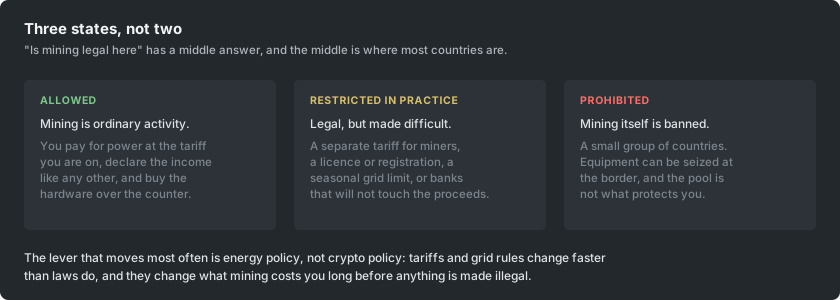
Allowed means mining is ordinary activity: you buy hardware over the counter, pay for power on a normal tariff and declare the income like any other. Prohibited means the activity itself is banned, and a small number of countries are in that group. China has banned mining since 2021 and the ban has held.
The middle state is where the interesting problems are. Mining is legal, and something else makes it hard: a separate and more expensive tariff for miners, a registration or licence requirement, a seasonal restriction when the grid is stressed, or banks that will not process the proceeds even though holding coins is lawful.
Energy policy is the lever that actually moves
If you are watching for the thing most likely to change your mining economics, watch the electricity regulator rather than the financial one. Tariff structures, connection rules and seasonal curtailment change far more often than laws do, they need no new legislation, and they can make an operation uneconomic without anything being made illegal.
This has already happened in several places at both national and regional level, in the form of moratoriums on new mining connections, mining specific tariff classes and outright seasonal shutdowns during peak demand. None of those are bans. All of them end the same way for the person paying the bill.
The tax shape, and a few examples
Almost every system that has addressed mining treats it as two separate events: the coins arriving, valued in your own currency at that moment, and the later sale or swap, measured against that first value. The dedicated article on mining and tax covers what to record and why the record is harder than the rule.
Where systems differ is in the rates and the framing, and a few of the larger markets are worth naming as examples of how differently the same activity can be treated. These are offered as illustrations of the range, not as a checklist, and each one should be confirmed against its own tax authority before you rely on it.
- United Kingdom: mined coins are treated as income at their value when received, and a later disposal is looked at separately under capital gains rules.
- Germany: mining and similar rewards are treated as income, and the country is unusual in how favourably it has treated long held assets on disposal.
- India: a flat rate on crypto gains with a withholding at source on transfers, and notably no offsetting of losses between assets, which changes the arithmetic of an unprofitable year.
- Australia: rewards are ordinary income at their value when received, with a discount available on gains from assets held beyond a year.
- Japan: the treatment of digital assets has been moving toward a separate flat regime rather than ordinary income rates, with the change phased in.
The pattern across all of them is the same: the receipt is an event whether or not you sell, and the size and organisation of the operation decides whether it is treated as a hobby or a business, which in turn decides what you can set against it.
What to check before you commit money
- Is mining itself lawful where you are, and is there a registration or licence step.
- Is there a tariff class for mining, or a rule against running commercial load on a residential connection. This one catches people who assumed the household rate applied.
- Can your bank receive the proceeds. In some markets the coins are legal and the banking is the obstacle.
- What happens at the border when hardware arrives, and whether mining equipment is treated differently from ordinary computer parts.
- What your obligation is at receipt, not just at sale, and what records the authority expects.
Where to look it up
Go to the primary sources. Your national tax authority publishes its own guidance on crypto assets in most countries, and it is both free and more current than any summary. Your electricity regulator or utility publishes the tariff schedule, which is the document that decides most of your economics. Where a licence exists, the issuing body lists the requirements.
Aggregated country by country tables online are useful for orientation and unreliable for decisions. They go stale quietly, and this subject changes often enough that stale is the normal condition.